
As the teacher described my eight-year-old daughter as smiley, keen to please, compliant, and always trying her best, I felt both proud and deeply sad at the same time.
I am grateful that she is seen positively within school. Yet I also know that this outward presentation does not reflect her full lived reality as a child with an internalised presentation of autism and several identified additional needs. Her distress is not overtly visible within the classroom environment, but invisibility does not mean absence.
“Her distress is not overtly visible within the classroom environment, but invisibility does not mean absence.”
The Author
I know the cost of the mask she wears each day. I see the exhaustion after school, the anxiety, the emotional dysregulation, the overwhelm, and the distress that emerges only when she finally reaches the safety of home. I understand that the discrepancy between the compliant, capable child at school and the struggling child outside of school can be difficult to comprehend for those without experience of neurodivergence and masking presentations.
However, I know my daughter deeply. I am her fiercest advocate and her greatest source of safety and support. I understand both the mask she presents to the world and the anxiety that exists beneath it. I support her not only through what others can see, but through everything she works so hard to hide.
And perhaps I understand because I remember. I remember what it was to be a girl behind the mask myself. That is why I will continue to advocate for my daughter – not simply for the child the world sees, but for the child behind the mask who needs our love and support.
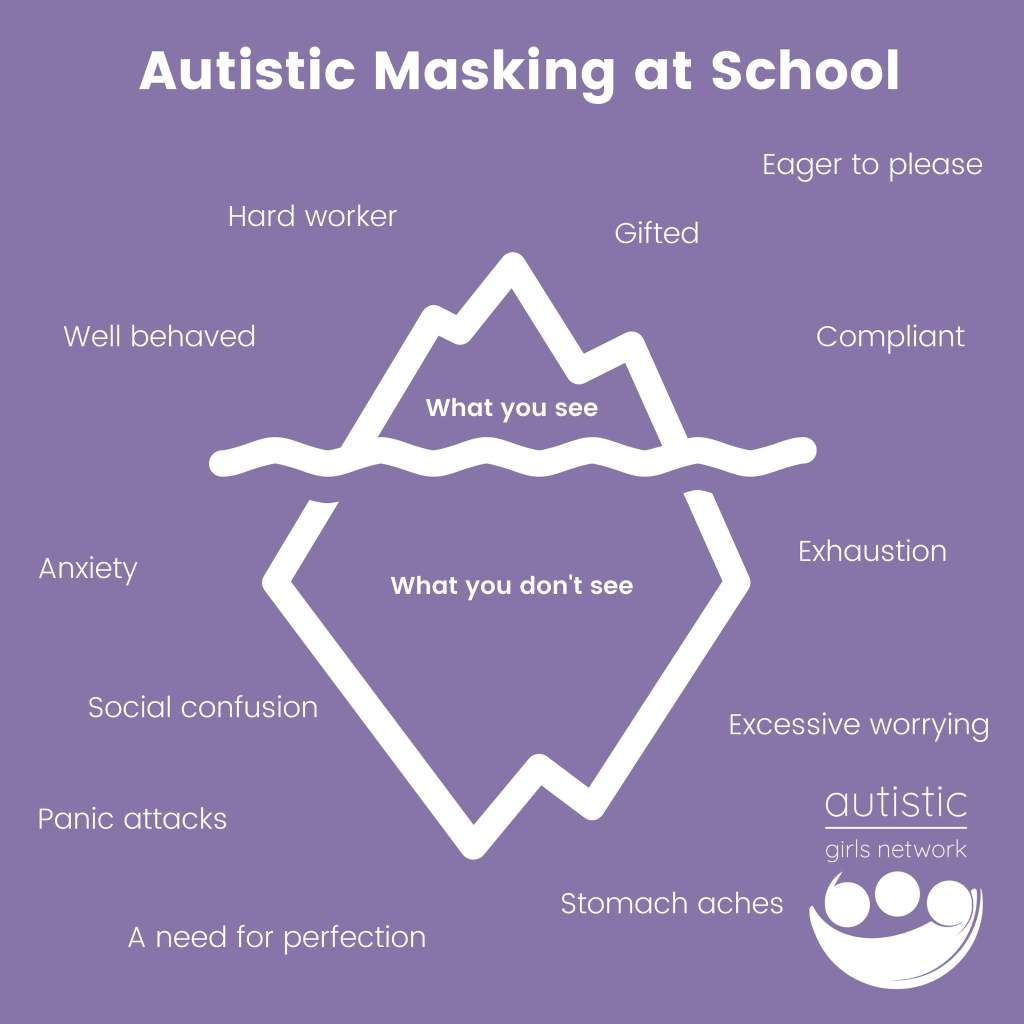
Diagram illustrating features of autistic masking at school. Created by the Autistic Girls Network and shared via Facebook.
A meltdown isn’t just a meltdown
Loving a child with a unique set of needs has taught me a different language entirely. It is a language of nuance, of tones and textures.
Just as a mother learns the different cries of her baby – how one sound signals hunger, another being overtired, another discomfort or pain – I have learned that my child’s meltdowns are not one thing. Each sounds different, is due to a different combination of needs and requires a different way of supporting.
There is the angry, upset dysregulation. The slam of a door, the retreat to a bedroom, the fierce need to be alone. I stand nearby, not intruding, but present, holding space for when the storm softens.
Then there is the complete overstimulation. The world has simply been too much – too loud, too bright, too busy. In these moments, words fall away. A blanket, a cuddle, a quiet corner. I don’t fix; I soothe. Offer a crunchy or chewy snack. I become a place of rest.
Sometimes anxiety takes the lead. It looks like hiding under the duvet, withdrawing, disappearing into small spaces. Fear wraps tightly around my child, and the world feels unsafe. I join her and I remind her that she is not alone.
“Fear wraps tightly around my child, and the world feels unsafe. I join her and I remind her that she is not alone.”
The Author
There are days when the overwhelm spills outward after an outing. Too many people, too many expectations, too much sensory input. Add to that an exhausted social battery, the weight of anticipation unmet, and the need to equalise, and it all erupts. These moments are layered, complex. I remind myself: this didn’t start here. My role is not to discipline the explosion but to understand the build-up.
And then there are the quieter forms of dysregulation. The kind that needs soothing, not solving. Dark evenings, heavy feelings, a nervous system that cannot settle. In these moments, I sit close and steady, a quiet presence in the same room.
Then there is distress due to an intense need for sensory input, excitement and dopamine, which seems to combine sensory seeking behaviour of autism with dopamine seeking of ADHD and intense dysregulation of PDA combined. Desperately shouting: “I’m bored, I am bored.”, with increasing intensity, rapidly escalating into a full meltdown. Boredom, not the type on a holiday afternoon reading on the bed. Boredom that is discomfort, agitation, an intense need for stimulation that cannot be easily satisfied. Every suggestion of an activity is wrong. Every option falls short. The frustration builds and spills into screams, into a desperate loop that even she cannot escape. It peaks with a frantic “help me, help me, help me mummy” cry. The intensity of the cry pierces my heart.
This is not the time for me to distract the child with humour, neither to step back to give them space to calm down. Empathising would just escalate the situation. The calm presence of a parent without any action would agitate the child further. The loving presence of a mom is not enough. Suggesting fun activities isn’t enough. This is the time when I need to help her transition out of the loop and to help her find her way back. Because the “help me, help me” cries can soon turn into “I don’t want to live anymore. The intensity is too much.”
“I am here with you and I will help you through this.”
The Author
I hug her tightly and we rock together for a long time. She needs me close, whilst also needing movement in her body. We try sensory input from cold water on the face, then an ice lolly. I am here with you and I will help you through this.
Sometimes presence, understanding and empathy is sufficiently soothing to ride out the wave of a meltdown. But in moments like these, she needs a calm presence, and also sensory stimulation. My challenge is to recognise the nuances of the distress and the different ways each need to be supported.
Permission to share granted by The Author on Thursday 21 May 2026
First published:
Last updated:
 Autistic Burnout - Family Stories
Leave a comment